Head versus heart in evaluation
Last Friday, I had a blast presenting at the Ohio Program Evaluators Group (OPEG) Spring Exchange about how we can use our evaluation skillset to empower and engage communities that are being silenced and harmed.
My presentation was the last one on a full-day agenda featuring the work of many skilled evaluators and analysts.
Each presentation brought something new to the table – a framework for policy analysis, a case study that used AI to help predict community voting outcomes, and a discussion of the utility of AI in data scraping for information to assess long-term program outcomes.
It was so interesting to engage in discussions about these different methods and techniques, most of which I knew very little about.
But while I was listening, I thought of one of my favorite bands: The Head and the Heart.
Not only is their music great, but I have always loved their name.
So much of this world feels like a struggle of the head versus the heart, so I have always appreciated their intentional “and.”
By the time it was time for me to present last week, I joked with the group that I was about to bring the warm and fuzzy to our conference.
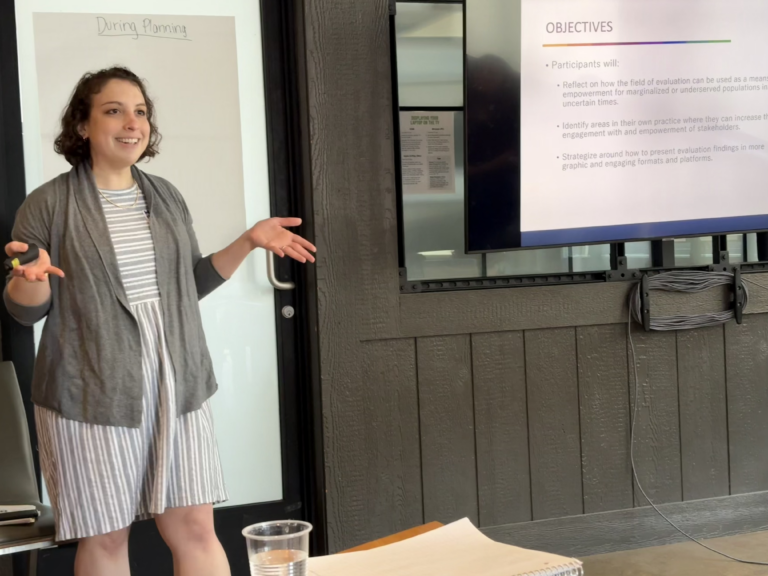
The first thing I had the group do was reflect on their mission or purpose as an evaluator.
We had spent all day in our heads. And that’s okay!
But now it was time to engage our hearts.
In the word cloud their responses created, here are some of the words that came up:
- Support
- Advocate
- Help
- Amplify
- Improve
Everyone just wanted to make the lives of people and communities better.
So how do we balance the head (methodology, intensive data analysis) with the heart (lifting up stakeholder voices, engaging the communities we’re trying to support) in this work?
Here are some of the ideas we talked about:
1) Engaging all types of stakeholders throughout your project to get input and make sure what you’re planning is culturally responsive and fits the community’s needs
This looks like: Conducting a needs assessment before you begin, conducting a pilot study of your survey tools to get feedback
2) Focusing on accessibility, not only in documents and surveys, but also in the ways and times we ask for people to participate
This looks like: Adding audio recordings, screen readers, or translations to surveys; Offering multiple time options for focus groups
3) Sharing results back with the people who informed them in fun, easy-to-interpret ways
This looks like: Creating infographics and social media posts that make it easy to understand and access results; following up with survey respondents or focus group participants to share what you learned
It’s so important for those of us who plan, implement, and/or evaluate real-life programs to think about how we’re lifting up the communities we’re working with.
There are so many easy ways to do that, which require little effort on our parts but have a big payoff in terms of community/stakeholder investment and empowerment.
How do you balance the head and the heart in your work?