I know I talk about data … a lot.
But for me, it’s really not about the numbers.
It’s not about the spreadsheets (I do still really love spreadsheets though).
It’s not about the reports and fancy graphs and charts.
It’s about the people behind those numbers.
Every row in a spreadsheet represents a person or family.
Every interviewee is someone taking time out of their busy life to tell their story and try to help.
When you work in or with child- and family-serving organizations, you’re not doing it for compliance or methodology … you’re doing it because you CARE.
You want to make other people’s lives better.
And that’s a beautiful thing.
That’s why I LOVE using qualitative data – findings and quotations from focus groups, interviews, observations, and even open-ended survey questions – to help people tell their own story.
Of course, numbers have impact. People take note when a startling statistic is shared.
But they remember stories.
And that’s why I get excited to train and coach community-based organizations on using both numbers and narrative to tell those stories.
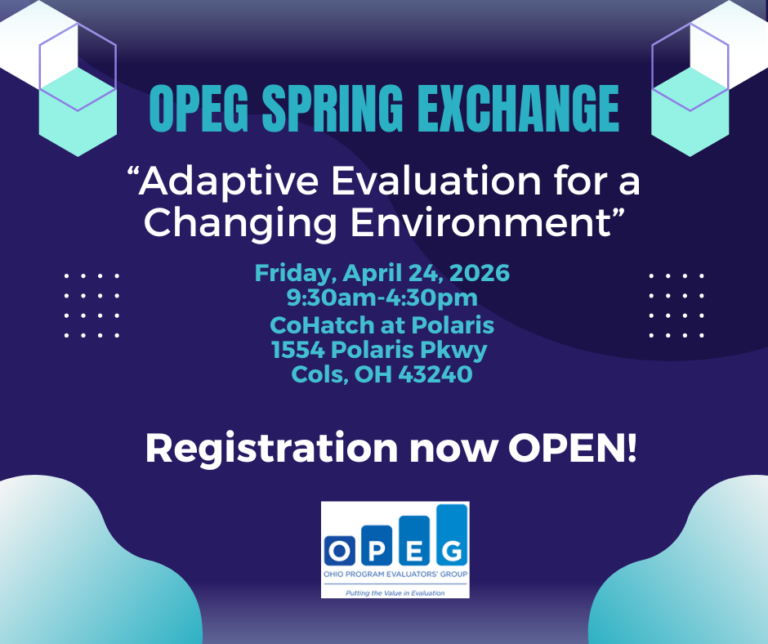
I’m also excited to return to my old professional home, the Ohio Program Evaluator’s Group (OPEG) on April 24th to present about how we can use our evaluation skillsets to lift up voices from communities being silenced and marginalized.
If you’re interested in joining us and participating in OPEG’s Spring Exchange, sign up here!